Gameplay-
Dragon Age: Origins is an action role-playing game. The player is a Grey Warden, part of an order of elite fighters, whose task is to defeat the Archdemon and save the world from a disastrous event called the Blight. Players create their own Grey Warden character, customizing gender and appearance as well as choosing a race and class. The available classes are warriors, who perform strong physical attacks; rogues, who carry out stealth attacks and steal items from other characters; and mages, who cast spells on enemies, create combo spells, and support other party members. The three choices of race are human, elf, and dwarf. The combination of class and race determines which of six different origin stories the player experiences: Dalish Elf, City Elf, Dwarven Noble, Dwarven Commoner, Mage, or Human Noble. This affects the way other in-game characters perceive the player's character; for instance, a Dwarven Commoner would receive hatred and discrimination from other dwarves. However, all classes follow the same plot after the completion of the origin story.During gameplay the player encounters a variety of enemies, including giant spiders, darkspawn, ghosts, walking trees, and dragons. They also recruit companions, who accompany them and provide assistance in battle. These companions are normally controlled by artificial intelligence, with behavior that the player can adjust through the "Tactic" menu, but the player also has the option to switch between characters, and is able to issue orders to them in real-time or pause the game to queue up actions.
Utilizing a third-person perspective, the combat in Origins is largely similar to BioWare's previous Star Wars: Knights of the Old Republic. The player and any companions engage in combat with the weapons they have equipped when the player targets or is noticed by a hostile enemy. Players can swap weapons and perform special attacks during combat, but most of these attacks have a recharge time. The point of view can be shifted from third person to a top-down view, where friendly and hostile units are labelled with different colors to distinguish them. At the end of a battle the characters' healthand stamina, which powers a character's skills, are automatically refilled. When an enemy is defeated, the player collects any items or loot from its corpse.
The player can level up their Warden character by earning experience points through completing quests and defeating enemies. Each time player levels up, they receive three points to spend on the character's six attributes. Strength inflicts more damage, dexterity helps evade attacks more often, willpower increases stamina, magic increases spell damage or magic defense, cunning improves combat tactics, and constitution helps withstand attacks. Special skills, which are divided into four different aspects for each class, and specialization options, which offer class-specific skills, can also be unlocked by levelling up.
Players can be accompanied by a maximum of three companions. Companions who are not in the player's active party stay in base camp, a hub where the player can talk to their party members as well as purchase new weapons, armor, and gear. In addition to the main story, the player can learn more about the world of Thedas by collecting the Indexes scattered throughout the game.
The game's dialogue engine is the same as that of Mass Effect. The player can talk and interact with both party members and other non-playable characters. A dialogue tree offers several dialogue options for the player to select. Through conversation, the player can unlock unique quests and dialogue revealing the lore of Dragon Age. It can also be used to persuade or intimidate other characters. The player often must choose between morally ambiguous options, which result in consequences that affect the game's world and progression, and can even lead to the death of a potential companion. Companions react to the player's choices through an "approval system". When they dislike or object to the player's decisions, their approval drops, which can result in a companion leaving the party or even attacking the Warden.Approval points can also be influenced by gifts, which will improve any companion's approval but are each intended for a specific companion. Some gifts, if given to the right character, start a cutscene and can even unlock a quest. A high approval rating improves a companion's morale and gives bonuses to their combat abilities. A significant approval rating also makes it possible for the Warden to pursue a romantic relationship with certain companions. The game's "interaction reactivity" system means that the way a player treats one companion affects the approval rating of other companions as well.

Plot-
Depending on the player's chosen race and class, they will begin the game with one of six predetermined origin stories. In each origin story, the player is introduced to Duncan, the commander of Ferelden's Grey Wardens, who is trying to find recruits to join the order. At the end of the origin story, the player's character is selected as a potential Grey Warden, and leaves with Duncan.
The player and Duncan journey to a fortress in southern Ferelden called Ostagar. There, they join Cailan, the King of Ferelden, and his father-in-law Loghain, a legendary general. The three leaders plan to make a stand against the encroaching Darkspawn before a new Blight overwhelms Ferelden. Duncan senses the influence of an Archdemon, a god-like being hosted in the body of a powerful Dragon that commands the Darkspawn, which makes this the first true Blight in over 400 years. Duncan emphasizes the importance of defeating the Blight before it can gain enough momentum to threaten the rest of Thedas.
Duncan initiates the player into the Grey Wardens through a dangerous ritual called the Joining. The Joining involves imbibing Darkspawn blood, which will either kill a person or imbue them with the powerful darkspawn essence known as the Taint, granting them the ability to sense Darkspawn and a rudimentary connection into their hive mind. After surviving the Joining, the player and another Grey Warden, Alistair, are given the task of lighting a beacon at the top of the fortress which will signal Loghain's men to charge the horde's flank. However, upon seeing the signal, Loghain abandons the battlefield with his army. Without Loghain's reinforcements, King Cailan and Duncan are overwhelmed and slain by the Darkspawn, who massacre Cailan's army, seize control of Ostagar and begin advancing into southern Ferelden.
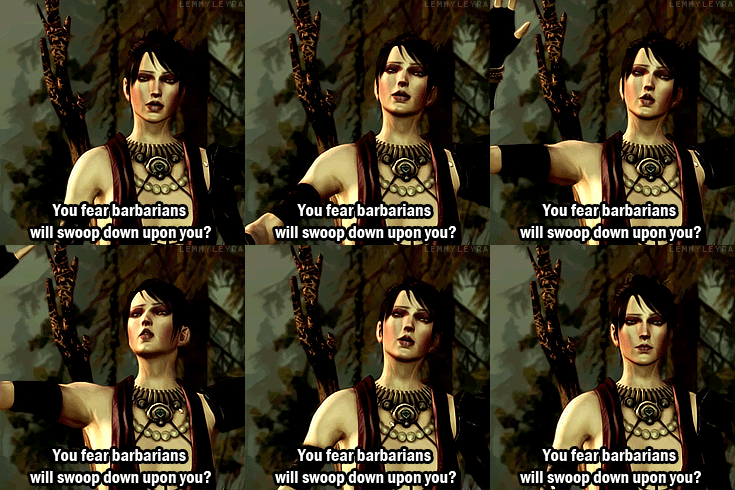
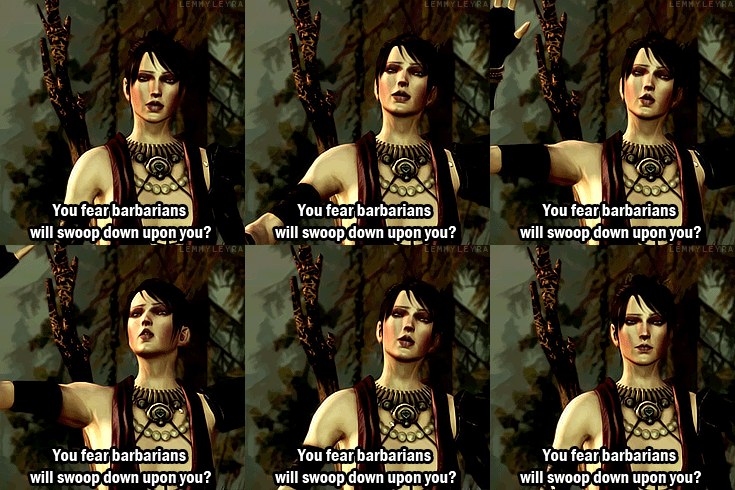
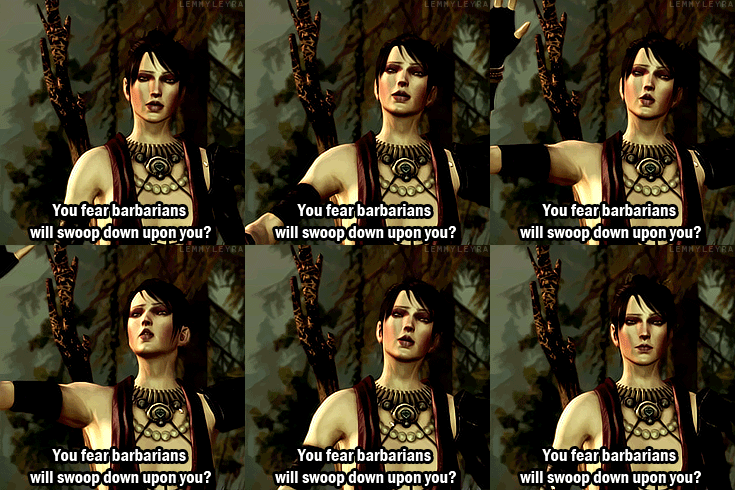
The player's Warden and Alistair are saved by Flemeth, a powerful witch who lives in a secluded hermitage with her daughter and apprentice, Morrigan. The player, Alistair, and Morrigan decide that in order to stop the Blight from destroying Ferelden, and possibly all of Thedas, they will need to gather a new army and slay the Archdemon. Using ancient Grey Warden treaties, the player's Warden must travel across Ferelden to enlist the aid of the Dalish Elves, the Dwarves of Orzammar, the Circle of Magi, and the soldiers of Redcliffe, loyal to Arl Eamon. In addition, Alistair reveals that he is a bastard son of King Maric Theirin, Cailin's father, putting him in contention for the recently vacated throne.
Meanwhile, Loghain returns to Ferelden's capital city, Denerim, to inform his daughter Queen Anora of King Cailan's death. Loghain uses the Grey Wardens as a scapegoat, blaming them for abandoning the battle and betraying Ferelden, outlawing the order and calling for the deaths of any remaining Wardens. While Anora inherits her husband's authority, Loghain quickly declares himself her regent and effectively seizes control of the kingdom. Loghain swiftly becomes a brutal and tyrannical ruler willing to do anything to retain power, igniting a civil war between himself and Ferelden's nobility, who refuse to acknowledge his authority. Both sides battle to an inconclusive stalemate, and the darkspawn take advantage of the chaos to advance further into Ferelden unopposed.
After the player successfully obtains the assistance of each of the primary factions, a Landsmeet is called among the nobles of Ferelden. There, the player confronts Loghain, ultimately either executing him or making him a Grey Warden (in which case he joins the party, replacing Alistair). The player also settles who will lead Ferelden against the Blight (Alistair, Anora, or both) and rallies support from the rest of the kingdom to face the Darkspawn. At this point, the player learns that only a Grey Warden can slay the Archdemon because of the Taint present in a Grey Warden's body. Killing the Archdemon releases the demonic essence within it, which is drawn to the Taint in the Grey Warden and effectively kills them as well; if anyone other than a Warden slays it, the Archdemon's essence survives and finds a new host in the nearest Darkspawn, making the monster effectively immortal.
On the night before the final battle, Morrigan offers the player's Warden a way to slay the Archdemon without sacrificing anyone: Morrigan believes that if the player succeeds in conceiving a child with her, the child would also carry the Taint. Once the Archdemon dies, its demonic essence would be drawn away from any Grey Warden to safely merge with the unborn child instead. The resulting child would be born a demigod, which she plans to raise on her own. The player can accept Morrigan's offer, convince Alistair or Loghain to take part instead, or refuse the witch's proposal, which will cause her to leave the party.
The next day, the player and the newly assembled army of Ferelden fight their way through the city of Denerim, which has been overrun by the Darkspawn. After fighting their way through the Darkspawn horde, and a final battle against the Archdemon atop Denerim's highest tower, the player is given the chance to deliver the killing blow or to let Alistair or Loghain do it. With each choice the Archdemon is killed and the leaderless Darkspawn army retreats from Denerim, marking the end of the Fifth Blight. Unless the ritual with Morrigan was performed, whoever slew the Archdemon also perishes. The story ends with a ceremony attended by the people of Ferelden during which the player and their companions are honored for saving the kingdom. The game then presents an epilogue in text and pictures which details the ramifications of the player's in-game choices on the future of Ferelden and the lives of his or her companions.
Development-
Dragon Age: Origins was created by the Edmonton studio of BioWare, the developer of Neverwinter Nights and Jade Empire. Development of the game began in November 2002. It was officially revealed at E3 2004 as simply Dragon Age, and was re-revealed as Dragon Age: Origins in July 2008, alongside a new trailer for the game. According to BioWare, they kept any information about the game hidden from the public, to further the game's design and technology.More than 180 people worked on the game, and full-scale production began three years after the game's initial development. The subtitle "Origins" was chosen to represent the six origins storyline, BioWare's return to PC role-playing games, and the beginning of a new franchise. Origins is a spiritual successor to Baldur's Gate and Neverwinter Nights, as an attempt to build a similar fantasy RPG without any licensing restrictions or issues. The similarities are mostly present in gameplay elements, such as real-time tactical combat; the game does not share the Dungeons and Dragons setting of the Baldur's Gate series, and is instead set in a period resembling the Stone Age or Iron Age, with dragons prevalent.
David Gaider, the lead writer for Origins, built the game's world first before writing the plot. The team chose a "fantasy" setting because Dan Tudge, the game's director, thought that BioWare was at its best in the fantasy genre. In the first draft, there were no Darkspawn or Grey Wardens, and mages were not allowed to use magic in cities. There were twelve different origin stories, including Human Commoner and Avvar, a barbarian origin. However, most of them were scrapped for being "ridiculous", leading to six stories being finalized. Loghain was the first character to be created, while an Ogre, nicknamed "Fluffy", and a human with medium armor were the first enemies designed. The concepts of Alistair and Morrigan were the next to be created, as they play the largest role in the game's plot. Their creation also took far longer than other characters. Morrigan was originally conceived to be similar to Flemeth, speaking whimsically. However, Gaider was not satisfied and decided to completely rewrite her personality. As a result, she was designed as a "blunt" person who always resists her mother. Finding a suitable voice actor for Morrigan took the most time of any character. The game's final version features 68,260 lines of dialogue; the quality assurance testers for the game enabled a cheat to automatically skip these cutscenes and dialogues during test runs.
Ray Muzyka, co-founder of BioWare, said that the team wanted to try something that would be new but familiar to most players. They hoped that Origins would redefine the genre to become The Lord of the Rings of video game franchises.Greg Zeschuk, another co-founder of BioWare, described the fantasy of Dragon Age as in between the high fantasy of J. R. R. Tolkien's works and the low fantasy of works by George R.R. Martin. The goal was a "dark heroic fantasy" that would suit the taste of any fan of the genre. Thus, while the game has the typical races of human, elf, and dwarf, they are slightly altered from the usual nature of the three races, and a new lizard-like race called the Qunari was introduced. Some of the alterations they made included flipping how certain races, like elves, are treated in other fictional worlds. While elves are often described as a race of high prestige in fiction, Dragon Age: Origins presents them as slaves of humans, labelled as second class citizens who resent the human race. This extended to the gameplay, where the player can choose todiscriminate against other races, and can experience discrimination from others based on their choices.
BioWare recognized that non-linear choices are an element unique to video games in the entertainment industry. Zeschuk called the sheer number of choices in the game "big" and "impactful", and the team designed many of those to be emotional and create a more personal experience for the player. They intentionally avoided adding a karma system, as the choices are designed to be ambiguous, with only the player to judge whether they are good or bad. According to Muzyka, their goal was to make players sympathize with events and characters, connecting with them to feel true emotions. This vision challenged the team to balance many key aspects, such as the amount of dialogue and animation in each cutscene, to create a believable scenario for players.
The team also hoped to handle romance in a more "mature" and "complicated" way, with a true reflection on human relationships and reactions rather than "adolescent titillation".
While Origins is a single-player-only game, Muzyka described it as a "social experience", considering the narrative and its variety of paths as an integral part of the gameplay. The characters a player meets, items they collect, and quests they receive and complete may be different, leading to a completely different experience. He also considered the ways a player explores the world and discovers new areas as an exploration narrative. As each player had different experience, they hoped that those players would collaborate to expand upon their knowledge of the world. To that effect, the team built a community site as an online social environment for players to communicate. Players could share stats and automatically generated screenshots with the community.
Release-
While the game was originally intended for PC, a console version was announced in 2008 by gaming magazine Game Informer. Prior to the announcement, Zeschuk suggested that the entire franchise has a "console future". The decision was made to bring the game to consoles to introduce it to a wider audience. Mike Laidlaw, the game's lead designer, considered creating the console versions' interface a challenge, as they has to convert the long and complex quickbar from the PC version to a more streamlined interface that could use the same actions with only few button presses. To that end, the team decided to map six different actions together, and allow players to customize the arrangement. Also, the console version does not allow the top-down view possible in the PC version.
The game was originally set to be released in early 2009 for Microsoft Windows, and later for PlayStation 3 and Xbox 360. The team partnered with Edge of Reality to develop the console versions of the game. However, its release date was pushed to the latter half of that year in order to have a simultaneous launch. BioWare announced that the game would be released on October 20, 2009, but pushed it back again to November 6, 2009, as the team wanted additional time to finalize some last-minute decisions. The PlayStation 3 version was at one point delayed to November 17, but did end up launching alongside the other versions. A Mac version of the game, developed by TransGaming, was released on December 21, 2009.
In addition to the standard version, other editions of Origins were made available for purchase. The Collector's Edition came in a SteelBook with different artwork. Like the standard edition, the Collector's Edition included a redemption code to obtain the Stone Prisoner and Blood Dragon Armor DLC for free, but added three additional exclusive in-game items, a bonus disc containing a making-of documentary, concept art, trailers, the game's original soundtrack, and a cloth map of Ferelden.The "Ultimate Edition", released on October 26, 2010, includes the base game, the Awakening expansion pack, and all 9 DLC packs.
The Dragon Age Character Creator was released on October 13, 2009, allowing players to create a character in advance and import it into the full game upon release. BioWare also released a "developer-grade" toolset to allow extensive modification and customization of the game's PC version. Players can use these tools to craft new campaigns, quests, cinematics, and lip-syncing.
On November 26, 2009, Electronic Arts announced a competition called Dragon Age: Warden’s Quest. Contestants formed groups of four people and competed to adventure through the game's world, with the winning group receiving $12,500.The representatives from Hungary won the contest, followed by a group called Bioware Community, Canada and a group from Poland. On March 9, 2011, Electronic Arts announced that players who pre-ordered Darkspore would receive a free copy of Origins. In 2012, to celebrate the first-year anniversary of Electronic Arts' own digital distribution software Origin, the game was made free to download alongside Battlefield: Bad Company 2 and Spore for a limited time. On October 8, 2015, it became free to download again for a limited time as part of Origin's On the House program.

Reception-
Dragon Age: Origins received critical acclaim from major video game critics upon its release. While the game is considered to be virtually identical across all platforms, differences in user interface, graphical performance, and online content delivery have led the PC version to be reviewed more favorably than the PlayStation 3 and Xbox 360 versions; Metacritic ranks the PC, PlayStation 3, and Xbox 360 versions of the game with scores of 91, 87, and 86, respectively.
The game's setting was well received by critics. Dave Snider from Giant Bombthought that the setting felt traditional due to the presence of dwarves and elves, but that the world was beautifully executed. He also appreciated the small touches BioWare added to the world, noting the "French-tinged accent" of the Orlesian Empire humans. He added that the six origin stories and their unique dialogue and referencing throughout the game make the world feel cohesive.Kevin VanOrd from GameSpot made similar comments, stating that the new ideas added to a familiar world make it feel original and new. However, Jeff Haynes from IGN said that the origin stories were inconsistent, with missteps that make the world, while "rich and vivid", feel less believable. Joe Juba fromGame Informer wrote that the world was well-realized with a deep history, which makes the game addicting, as players can sense their Warden's importance in the world.
The game's story and characters also received praise. Snider said that the story is driven by the characters, and that the choices presented in the game were difficult, making him regret some choices for weeks after completing the game. He added that the game's main quest was well-written, and its quality boosted by excellent voice acting; he called the performance of Claudia Black as Morrigan one of the best in the game. VanOrd commended the game's story, saying that it was memorable and crafted with care, successfully making players care about the game's world and characters. He added that the deep character development made every choice "momentous".GamesRadar thought that the story and the Warden's appearance felt generic, but that the story become more and more engrossing as it progressed. Nick Tan fromGame Revolution liked the banter between companions as a humorous change of pace within the game. Gerald Villoria from GameSpy praised the exclusion of the moral system for making the characters feel more complex. Juba wrote that the story was good but predictable, not straying far from standard fantasy stories. Wesley Yin-Poole fromVideoGamer.com called the story memorable, saying that it "leaves an itch in your mind", and has attracted players to return to the game "like an addict seeking a hit of relief."
As for the game's combat, Snider called it streamlined, but said that players who do not want to use the pause mechanic would not be able to appreciate the game, as the combat requires both patience and strategy. He liked the game's third-person view more than the top-down view, saying that being able to view the sky made environments feel more complicated, and praised the high difficulty of boss battles, which task players to manage their stamina carefully. His conclusion was thatOrigins "feels like a real throwback to the good old days of PC role-playing epics." VanOrd said that the combat system was easily recognizable for players who have played other RPGs developed by BioWare. He added that players can have a lot of fun switching between characters, and agreed that the game had created thrilling boss battles. He praised the choice to have health and stamina replenish immediately after battles, as it sped up combat pace and flow. Tan also commended the combat, finding it a better system than other BioWare RPGs, but disliked the fact that characters can step into water.Juba praised the amount of space for players to experiment with new skills and abilities, adding that the required focus and attention make combat very satisfying.
The game's graphics received mixed reviews. VanOrd was not impressed, stating that the environments do not look as good viewed from a top-down perspective, but he praised the art style and some of the game's "eye-catching" landmarks. Tan liked that the environments were varied and unique, saying that each level felt "vast" and filled with details. Villoria found its visual quality lacking when compared with that of Mass Effect 2, adding that the facial animation can feel wooden at times. However, he found the combat animation rewarding and satisfying.
GamesRadar estimated that there are more than 80 hours of content available in the game. Villoria called the world engaging, and its replay value very high, as players can play the story over and over again with a different origin.Juba agreed,as did Yin-Poole, who added that the way companions react to the player's decisions, as well as the six origin stories, significantly expand the game's longevity.
Comics-
Dragon Age: Origins, a webcomic by the artist of Penny Arcade, was made available in 2010, and it tells a story about a group of Templars sent on a search & destroy mission for Flemeth, the Witch of the Wilds. The timeline is set before the game Dragon Age: Origins, as Morrigan has not yet been recruited by The Warden.
Another webcomic, Dragon Age: Origins - Awakening, was also released in 2010 by Penny Arcade. This short story tells how Nathaniel Howe broke into Vigils Keep prior to his arrest in Awakening right before meeting The Warden.
Dragon Age: The Revelation, written by David Gaider, was published in 2010 on BioWare's website, and features art from Aimo. The story is based on a script from the video game Dragon Age: Origins that did not make the final release. It details a meeting between Morrigan and Alistair after the Grey Wardens learn from Riordan that in order to kill an Archdemon the warden who slays the beast must die. Morrigan seeks out Alistair to ask his advice on the lengths one would go to help a friend in need. The story assumes a female warden as Duncan's last recruit, and ends with Morrigan on her way to Alistair's bedroom to offer The Dark Ritual.
Three graphic novels and a series of comic books have also been released: Dragon Age, a 133-page story written by Orson Scott Card with the help of Aaron Johnson and released by IDW Publishing in 2011, tells the story of a mage becoming romantically involved with a templar. It was originally released in 6 individual comics but was collected and issued in a single graphic novel. The story is set before the events of the video games and takes place in and around the Tower of Magi.
A second series of graphic novels set after the events of Dragon Age: Origins and Dragon Age II were released beginning in 2012. The novels were The Silent Grove, Those Who Speak, and Until We Sleep. The Silent Grove follows Alistair, Varric and Isabela as they uncover the truth behind Alistair's past. It is written by David Gaider. The second and third graphic novels in the series, Those Who Speak and Until We Sleep, were released as well by Dark Horse Comics in the same plotline, and later re-released in a 'Library Edition' compilation.
The third series of graphic novels, titled Dragon Age: Magekiller, is set during and after the events of Dragon Age: Inquisition. Written by Greg Rucka, the story follows Marius, a mage-hunting mercenary, and Tessa Forsythia, his assistant, as they progress through Thedas to seek for their targets. The story aims at "expanding the world of Dragon Age", and will involve areas that is never shown in the Dragon Age games. The first issue of the comic was released on December 16, 2015.